
Billing & credit control
Get paid on time without anyone having to be the bad guy.
Credit control is the job nobody at a firm wants and everybody postpones, which is why the debtor days quietly climb. The Link collects by Direct Debit against a mandate the client set up when they signed, raises the invoice in the firm's own ledger, chases on a ladder that escalates by itself, and puts a client on credit hold when the partner says so — with a name against that decision.
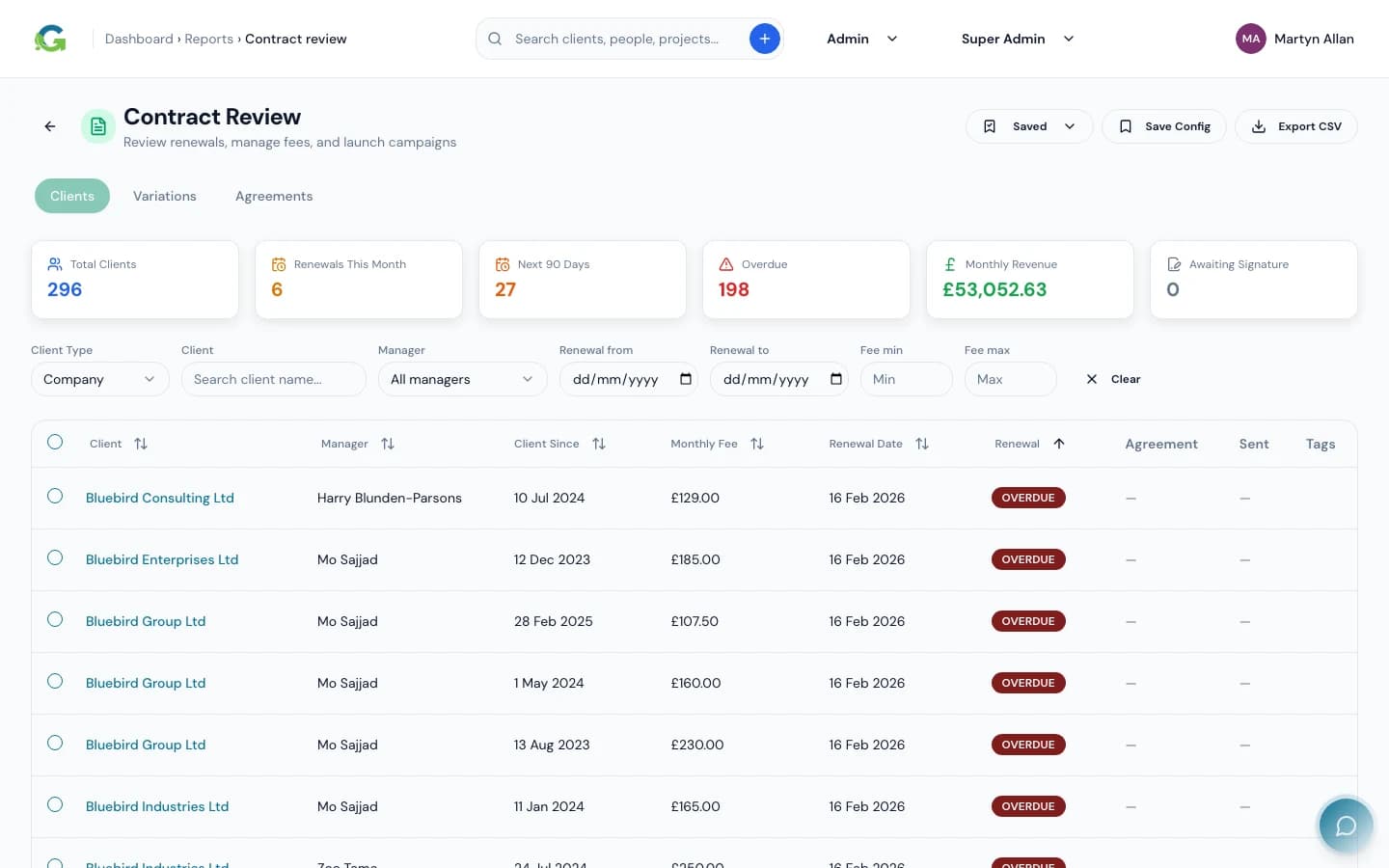
What it does
Direct Debit mandates
Set up a mandate from the client record or from the proposal they are signing. The mandate's state is visible and honest — pending with the bank, live, failed, cancelled — rather than a single flag that means four different things.
Recurring billing that follows the engagement
Monthly or annual fees collected on a schedule tied to what the client actually signed up for. Change the engagement and the billing follows, instead of the two drifting apart until somebody notices at year end.
One-off payment links
Raise a payment link for an ad-hoc piece of work, send it, and see whether it was opened, paid or ignored. A link can be taken back if it was raised in error, and the record says who did it.
Chase ladders that escalate on their own
Overdue accounts are chased on a defined ladder with increasing firmness. Nobody has to decide each morning who to email, and the client hears from the firm consistently rather than whenever somebody got round to it.
Credit hold, with a name on it
Put a client on hold from where the money decisions already are. It records who decided and why, so the conversation three weeks later is about the decision rather than about who made it.
Invoices raised in your own ledger
The invoice is created in the firm's QuickBooks or Xero, with the firm's VAT treatment, and the payment is matched back against it when it settles. Your ledger stays the source of truth for your accounts.
Profitability per client
Time recorded against fees charged, so you can see which clients are worth what you think they are. Undercharging shows up as a pattern rather than as a feeling.
Direct Debit collection and dunning software
Connected to
Every one of these is wired, with token storage, error handling and — where the provider needs it — a refresh job that keeps the connection alive.
- Adfin
- QuickBooks Online
- Xero
The rest of the platform
Practice management
Jobs, stages, owners, capacity and time — the spine the rest of the firm hangs off.
Communications
Email, calls, meetings, internal chat and campaigns — all attached to the client they belong to.
Compliance
HMRC, Companies House, AML and the audit trail that proves all three were done.
Bookkeeping
Bank statements, receipts and supplier documents read by AI and pushed to the ledger — without a separate auto-entry licence.
Proposals & engagement
Scoped proposals, engagement letters and e-signature — signed, countersigned and filed without leaving the platform.
Reporting & intelligence
Thirty named reports, a pivot builder, and an AI you can ask questions of in plain English.
Client experience
What your clients actually touch — the portal, the app, and every page they land on to approve, sign or send you something.
See billing & credit control against your own firm.
Thirty minutes, screen shared, your work on the table. Or answer six questions and get a deck built around what you said matters.